
An inverter PTAC speeds its compressor up and down to match the room, instead of switching fully on and off like most PTAC units. As a result, it gives steadier temperatures, lower sound levels and better efficiency, for a higher price.
TL;DR
- Variable output instead of on/off. A Genuine Comfort Ultra 12,000 BTU inverter PTAC cools anywhere from 5,000 to 14,500 BTU. A standard Elite 12,000 BTU PTAC runs at a fixed 11,800 to 12,000 BTU.
- Rated on the newer scales. The 12,000 BTU Ultra scores EER2 12.8 and SEER2 20.5, with a heating COP of 3.8.
- Quiet at low speed. The 9,000 BTU Ultra runs as low as 26 dBA on fan only and 31 dBA in cooling mode.
- Same box, same sleeve. Inverter and standard Genuine Comfort PTACs both fit a standard 42″ x 16″ wall sleeve and carry the same 6-year parts warranty.
- Cold climates need the Low Ambient version. Standard models heat with the heat pump down to 23°F. However, the Ultra Low Ambient (-L) models keep heating with the heat pump down to -22°F.
The Short Answer
An inverter PTAC is worth it for rooms that run many hours a day, rooms where noise matters, and buildings in colder climates. Its compressor slows down when the room needs less cooling or heating, so it spends most of its time running gently instead of starting and stopping at full power. Genuine Comfort rates its Ultra inverter PTACs on the newer EER2 and SEER2 scales, with seasonal ratings of SEER2 19 to 22 on the standard models.
A standard PTAC is still the better buy when the upfront price matters most, the room gets only a few hours of use a day, or the unit is replacing a like-for-like model in a building that is happy with it. Also, both types fit the same 42″ x 16″ wall sleeve, so the choice comes down to how the room is used.
What Is an Inverter PTAC
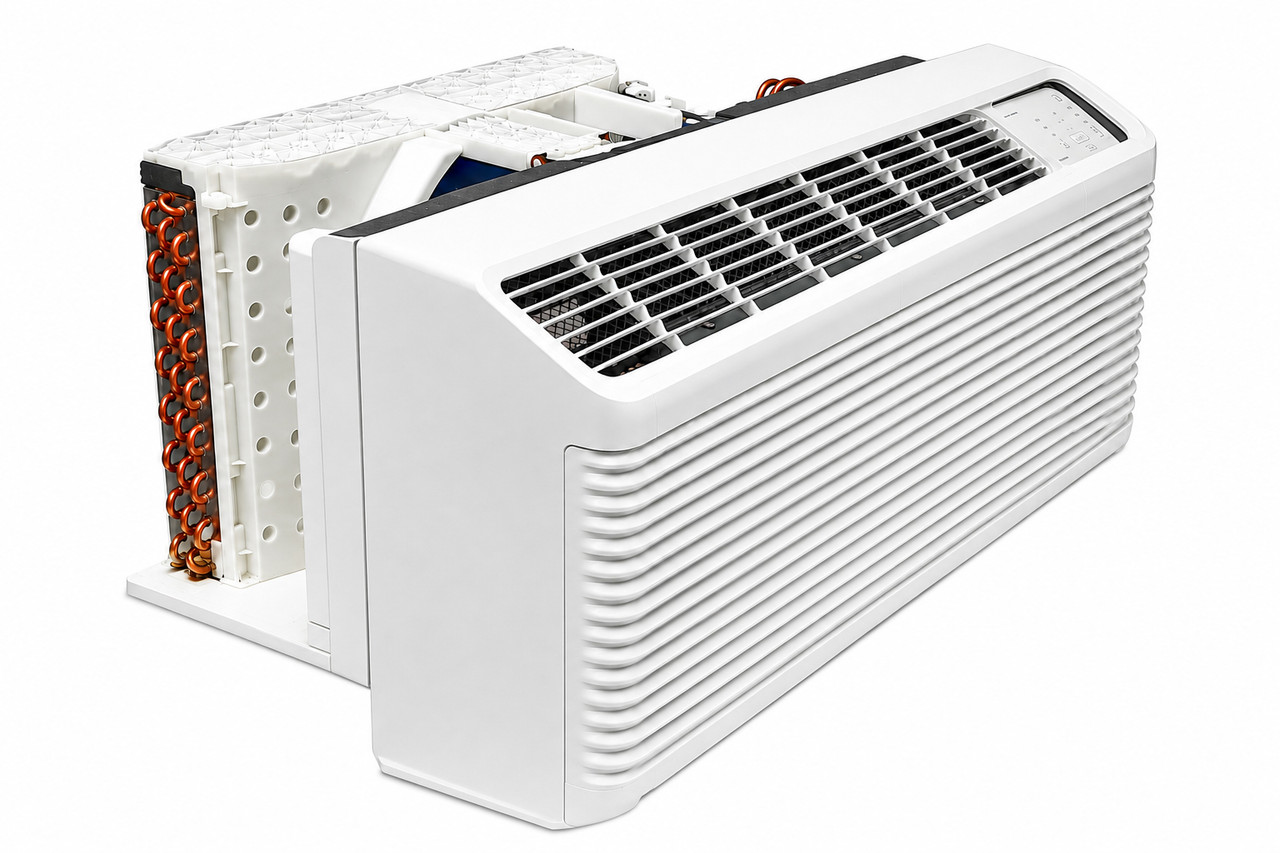
A PTAC (packaged terminal air conditioner) is the through-the-wall unit found in hotels, apartments and senior living. A standard PTAC has a single-speed compressor. It runs at full power until the room reaches the set temperature, shuts off, and starts again at full power when the temperature drifts.
An inverter PTAC uses a variable-speed compressor. The inverter is the electronic drive that changes the compressor’s speed. For example, think of a dimmer instead of a light switch. A U.S. Department of Energy field study of cold-climate heat pumps explains that an inverter modulates compressor speed so the heat pump can adjust its output, which makes it more efficient at part load.
Part load is the key idea. A room rarely needs a unit’s full capacity. For instance, on a mild day a room might need only a fraction of it, and a variable-speed unit can run at that lower level instead of cycling.
| Standard PTAC | Inverter PTAC | |
|---|---|---|
| Compressor | Single speed: full on or off | Variable speed |
| How it holds temperature | Cycles on and off around the set point | Slows down and keeps running near the set point |
| Best efficiency | At full load | At part load, where most hours are spent |
| Sound | Full-power starts and stops | Lower speeds most of the time |
| Upfront price | Lower | Higher |
Inverter vs Standard PTAC: Genuine Comfort Specs Side by Side
The clearest way to see the difference is two units of the same size from the same maker. The table compares the Genuine Comfort Ultra (inverter) and Elite (standard) 12,000 BTU heat pump models at 208/230V.
| 12,000 BTU heat pump, 208/230V | Elite (standard) | Ultra (inverter) |
|---|---|---|
| Cooling output | Fixed 11,800 / 12,000 BTU (208V / 230V) | Variable 5,000 to 14,500 BTU |
| Heat pump heating output | Fixed 10,500 / 10,800 BTU (208V / 230V) | Variable 5,000 to 14,500 BTU (12,000 BTU nominal) |
| Efficiency rating | EER 11.6 | EER2 12.8, SEER2 20.5 |
| Heating efficiency | Not published | COP 3.8 |
| Lowest indoor sound | Not published | 27 dBA fan only, 31 dBA cooling |
| Heat pump heating down to | 23°F (–5°C) outdoors | 23°F standard, –22°F on Low Ambient (-L) models |
| Wall sleeve | 42″ x 16″ | 42″ x 16″ |
| Refrigerant | R-32 | R-32 |
| Parts warranty | 6 years (Genuine Care) | 6 years (Genuine Care) |
One caution on the efficiency row. Genuine Comfort rates the Elite on the older EER scale and the Ultra on the newer EER2 and SEER2 scales, which use different test conditions. So although higher is better on all three, the numbers are not a like-for-like comparison. For what the ratings mean, see What Is a Good EER Rating.
Benefits of an Inverter PTAC
Steadier room temperature
A standard PTAC overshoots and undershoots as it cycles. By contrast, an inverter PTAC slows down as the room approaches the set point and keeps running at low speed, so the temperature stays closer to what the guest or tenant chose. The Ultra 12,000 BTU model can turn its cooling down to 5,000 BTU, well under half its rated size.
Better efficiency where the hours are
Seasonal ratings such as SEER2 count the many hours a unit spends at part load, which is where a variable-speed compressor gains the most. Here are the ratings for the full Ultra range:
| Ultra model | Cooling range (BTU) | EER2 | SEER2 | Heating COP |
|---|---|---|---|---|
| 9,000 BTU | 4,000 to 11,000 | 13.5 | 22 | 4.0 |
| 12,000 BTU | 5,000 to 14,500 | 12.8 | 20.5 | 3.8 |
| 15,000 BTU | 5,000 to 15,500 | 11.5 | 19 | 3.7 |
COP (coefficient of performance) is heating output divided by electricity used. A COP of 3.8 means the heat pump delivers 3.8 units of heat for each unit of electricity, while a resistance electric heater delivers 1. Actual savings depend on climate, room use and local power rates, so no fixed dollar figure applies to every building.
Lower sound levels
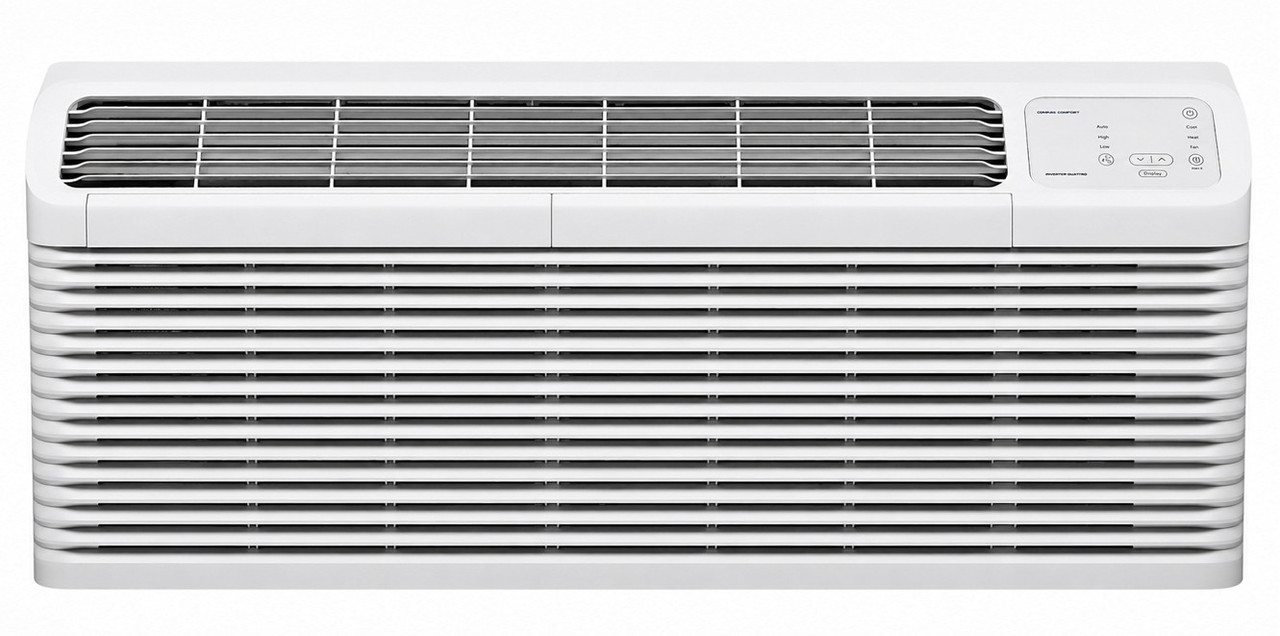
Genuine Comfort lists the inverter compressor and dual DC fan motors as features for lower noise. The Ultra spec sheet publishes these indoor sound levels at the lowest setting:
| Ultra model | Fan only, lowest | Cooling mode, lowest | Cooling mode, highest |
|---|---|---|---|
| 9,000 BTU | 26 dBA | 31 dBA | 46 dBA |
| 12,000 BTU | 27 dBA | 31 dBA | 46 dBA |
| 15,000 BTU | 34 dBA | 31 dBA | 49.5 dBA |
Still, an inverter PTAC is not silent at top speed. The benefit is that it spends most of its hours at the lower speeds, which matters in hotel rooms and bedrooms at night.
Moisture removal
Running longer at low speed can give the indoor coil more time to pull moisture from the air. Genuine Comfort rates the Ultra at 1.61 pints per hour (9,000 BTU), 3.51 pints per hour (12,000 BTU) and 4.29 pints per hour (15,000 BTU).
Inverter PTACs in Cold Weather
A heat pump PTAC heats by moving heat from outdoor air into the room, and switches to its electric heater when it gets too cold outside. Standard Ultra and Elite heat pumps both keep heating with the heat pump down to 23°F (–5°C).
Genuine Comfort also builds Ultra Low Ambient (-L) models, which keep heating with the heat pump down to –22°F (–30°C). The spec sheet lists how much heat they still deliver as it gets colder:
| Outdoor temperature | Ultra 9,000 -L | Ultra 12,000 -L | Ultra 15,000 -L |
|---|---|---|---|
| 5°F (–15°C) | 10,500 BTU | 12,000 BTU | 14,000 BTU |
| –4°F (–20°C) | 8,900 BTU | 10,000 BTU | 12,000 BTU |
| –13°F (–25°C) | 6,600 BTU | 8,500 BTU | 9,400 BTU |
| –22°F (–30°C) | 5,300 BTU | 7,200 BTU | 8,000 BTU |
| HSPF2 (heating season rating) | 11 | 9.8 | 9.3 |
In other words, every hour the heat pump covers is an hour the electric heater stays off. For pre-season checks on any heat pump PTAC, see How to Get Your PTAC Ready for Winter.
Trade-Offs to Weigh Before You Buy
- Higher upfront price. An inverter PTAC costs noticeably more than a standard model of the same size. Compare current prices on the product pages.
- More electronics. The variable-speed drive adds a control board that a single-speed unit does not have. Use the correct dedicated circuit and the supplied LCDI cord, and never an extension cord.
- Ratings are not apples to apples. Makers often rate inverter models on EER2 and SEER2 but standard models on EER, so compare within the same scale.
- Fewer size and voltage options. The Ultra line covers 9,000, 12,000 and 15,000 BTU at 208/230V. The Elite line also offers 7,000 BTU and 265V models.
On warranty, the two Genuine Comfort lines match: both carry the Genuine Care 1-year unit replacement (if parts and labor are not available) and 6-year parts coverage.

Who Should Choose an Inverter PTAC
| Choose an inverter PTAC if | A standard PTAC is likely enough if |
|---|---|
| Guests or residents fill the rooms most of the day, such as apartments, senior living or extended-stay hotels | Rooms see only a few hours of use a day or sit empty for long stretches |
| Noise complaints are a problem, especially at night | Noise has not been an issue |
| Winters are cold and heat pump hours matter (consider the -L models) | The climate is mild and heating is rare |
| Steady temperature and humidity matter to guests or residents | Upfront price is the main deciding factor |
| The building is upgrading for efficiency | The job is a quick like-for-like swap across many identical rooms |
A property can also mix the two, with inverter units in the rooms where comfort and quiet matter most and standard units elsewhere. Since both fit the same sleeve, a room can move to an inverter unit at its next replacement.
Shopping for an Inverter PTAC
Check three things before ordering. First, the sleeve: Genuine Comfort Ultra units fit a standard 42″ x 16″ sleeve. Second, the circuit: the Ultra comes with 15, 20 or 30 amp LCDI cords, matched to 2.5, 3.5 or 5 kW electric heaters. Third, the size: the BTU sizing guide covers how to match capacity to the room.
The Genuine Comfort lineup includes both the Ultra inverter and Elite standard series. For help choosing between them for a specific building, call PTAC4Less at 833-782-2453.
Frequently Asked Questions
An inverter PTAC is a through-the-wall air conditioner or heat pump with a variable-speed compressor. Instead of cycling between full power and off, it speeds up and slows down to match the room. Genuine Comfort Ultra Series units are inverter PTACs.
An inverter PTAC is usually worth it for rooms that run many hours a day, rooms where noise matters, and colder climates. However, a standard PTAC is often the better value for rooms that sit empty most of the day, or when upfront price matters most.
Inverter PTACs spend most of their time at lower speeds, which keeps sound levels down. For example, the Genuine Comfort Ultra 9,000 BTU runs as quiet as 26 dBA on fan only and 31 dBA in cooling mode, but it reaches 46 dBA at full speed.
Standard Genuine Comfort Ultra models heat with the heat pump down to 23°F, then switch to their electric heater. The Ultra Low Ambient (-L) models keep heat pump heating going down to -22°F, where the 12,000 BTU model still delivers 7,200 BTU.
Yes. Genuine Comfort Ultra inverter PTACs fit a standard 42″ x 16″ wall sleeve, the same size as the Elite series. Still, check the sleeve size and condition before ordering a replacement.
Both measure cooling output per watt of electricity, but EER2 uses newer test conditions. Because the scales do not line up number for number, compare PTACs on the same scale. Higher is better on both.